


Sabir Cardigan
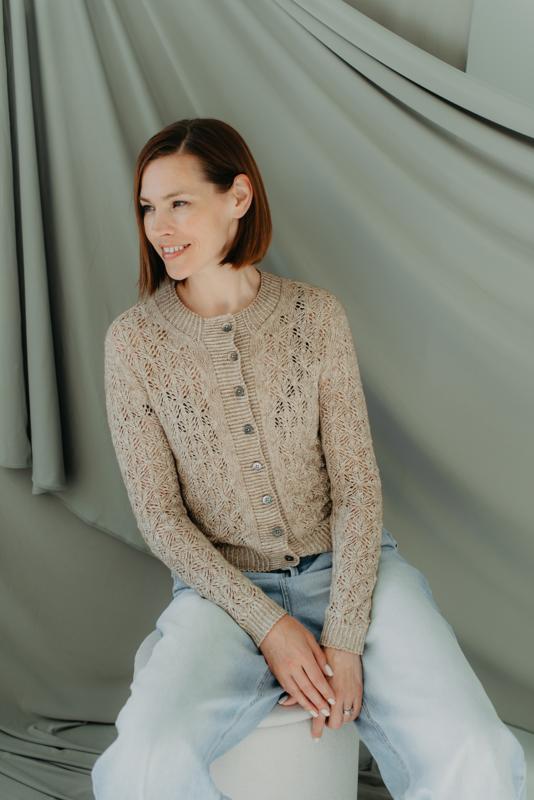
The Sabir Cardigan was born from a desire to create something special for my other half, but this time, with a playful twist. It gives the impressive, timeless look of an Aran-style cardigan, but without a single cable used.
This is a digital knitting pattern in PDF format, not a finished item.
Construction
Seamless
Yarn Weight
DK
Difficulty
Advanced intermediate
Sizes
1 (2, 3, 4, 5, 6, 7, 8, 9)
Gauge
20 sts & 40 rows = 10 cm / 4"
Languages
🇬🇧 English, 🇩🇰 Danish, 🇳🇱 Dutch, 🇫🇷 French, 🇩🇪 German, 🇪🇸 Spanish, 🇵🇹 Portuguese
Description
The Sabir Cardigan was born from a desire to create something special for my other half, but this time, with a playful twist. I decided to set aside his preference for "plain and simple" and instead create a garment full of texture. The initial inspiration came from a VKL class with the talented André de Castro, who introduced me to the world of tuck and woven stitches.
At the heart of the Sabir Cardigan is a bit of knitting magic: it gives the impressive, timeless look of an Aran-style cardigan, but without a single cable used. The honeycomb-like texture is created using a combination of slipped and tuck stitches. This technique was actually a happy accident, chosen because the row gauge of the slip stitch pattern meant traditional cables wouldn't work. Finishing details include double-knit button bands that provide structure and a clean edge.
This pattern is made for DK weight yarn, bringing dimension to the stitch patterns. However, the yarn should be light and airy, as the stitch patterns are yarn-hungry, and with denser yarns, the result would be quite heavy. I recommend using solid colours to bring out the texture in this pattern.
Sizing & Measurements
Sizes: 1 (2, 3, 4, 5, 6, 7, 8, 9)
Finished chest circumference:
98 (108, 118, 128, 138, 148, 158, 168, 178) cm
39¼ (43¼, 47¼, 51¼, 55¼, 59¼, 63¼, 67¼, 71¼)”
Designed to be worn with 15-20 cm / 6-8” positive ease around the chest.
Yarn & Gauge
Gauge
Diamond Honeycomb stitch pattern on larger needles, worked flat, blocked.
Mock Cable (MoC) repeat (32 sts x 12 rows): 12.5 x 3 cm / 5 x 1¼”
Diamond Honeycomb (DH) repeat (6 sts x 12 rows): 3 x 3 cm /1¼ x 1¼”
Yardage
DK weight yarn. Depending on the length of the cardigan, allow approximately:
1640 (1665, 1785, 1870, 1980, 2085, 2175, 2300, 2400) m
1790 (1815, 1945, 2040, 2160, 2275, 2375, 2510, 2620) yds
Yarn in Sample
Yarn used in the sample (size 5) is 8 skeins of Les Garçons British DK (70% BFL Wool, 30% Masham Wool, non-superwash; 250 m [273 yds] / 100 g) in colourway Jonathan x Laurianne.
Materials
Needles
- 4.00 mm (US 6) or needle size that gets the gauge; circulars 60-100 cm / 24-40″ long and (optional) DPNs for small circumference knitting
- 3.25 mm (US 3) or 2-3 sizes smaller needles than gauge needles; circulars 60-100 cm / 24-40″ long and (optional) DPNs for small circumference knitting
Notions
Stitch markers, locking markers, bobby pins or locking markers for tuck stitches, spare circular needle in smaller size, row counter, scissors, tape measure, stitch holders or waste yarn, tapestry needle, 6-10 22-30 mm / 1-1¼” buttons.
Other Notes
Techniques
Lifted increases, slip stitch knitting, tuck stitches, Backwards loop cast-on, knitting in the round, double-knitting, grafting.
Notes
The cardigan is worked seamlessly and flat from the top-down. It starts by casting on stitches for the back neckline and shaping the shoulders using lifted increases.
Stitches are then picked up along the back shoulders to create the front shoulders, working each side separately with increases to shape the front neckline.
Next, stitches are picked up along the front shoulder edges, and the yoke is worked in one piece down to the underarm. Increases are added along the neckline, sleeves, and body during this section.
The sleeves are separated, and the body is worked in one piece down to the hem. The hem is finished with a 2x2 rib.
The sleeves are worked separately in the round down to the cuffs, with decreases, and finished with the same 2x2 rib as the hem.
The double-layered collar is added by picking up stitches along the neckline and working in the round to the desired height and the two layers grafted together.
Finally, double-knit button bands are added by picking up stitches along the front opening edges, incorporating vertical buttonholes.
Video Tutorial

More to explore
You might also like


New patterns, test calls, and fun community events almost weekly
Join 20,000+ subscribers who receive our boutique updates first.
- New pattern release announcements
- Test call invitations for new designs
- Knit-alongs and community events
Unsubscribe any time.